
Project


For 60 years, EuroShop has been the most important meeting point for the international retail industry. The upcoming edition of the trade fair (February 22–26, 2026) once again promises a firework of innovations, with more than 1,800 exhibitors from over 60 countries and around 85,000 visitors from all over the world expected to attend.
“Agentic Commerce” was the key topic at the retail industry gathering NRF in New York this January. The event at the start of the year offered a preview of the trend topics that will dominate EuroShop in Düsseldorf just a few weeks later. In Europe, Agentic Commerce is still in its infancy, but many retailers are already exploring the potential of self-learning agents. A prominent practical example comes from Walmart: the U.S. retailer recently announced plans to link Google’s Gemini AI assistant in the U.S. with its product range and loyalty programs. Customers will then receive context-based product recommendations based on their previous online and in-store purchases.
Agentic Commerce will be tangible at many EuroShop stands: software developer Slimstock demonstrates how autonomous agents coordinate product life cycles, supplier information, and master data before feeding into operational retail processes. The quality of this data is increasingly becoming a competitive factor. Fraunhofer IAIS presents a scientifically grounded approach with “RetAIl Assortment Fit”: the multi-agent system links external market and trend signals with internal objectives to dynamically and proactively optimize assortments.
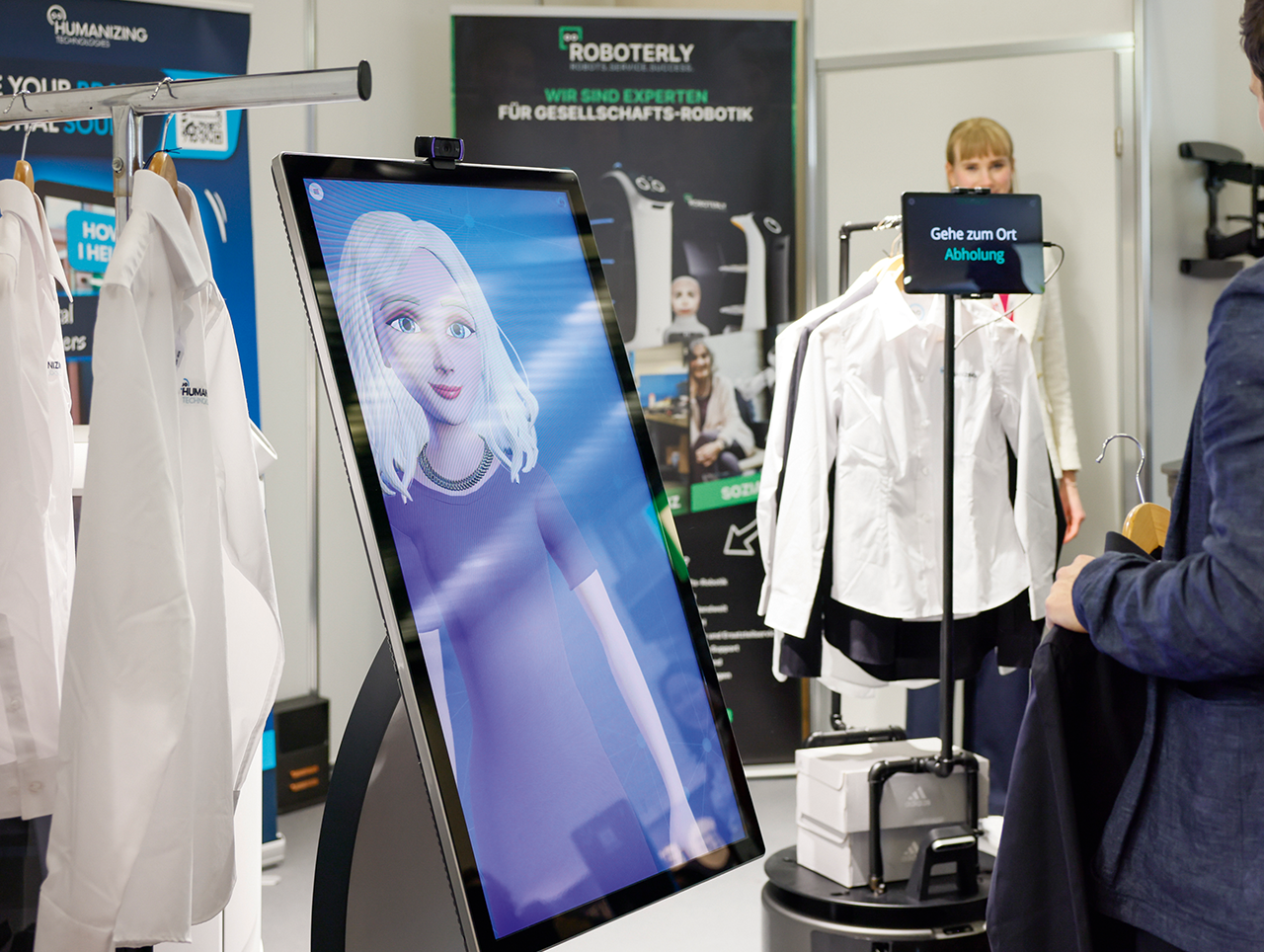
Seven presentation and discussion forums – all located within the exhibition halls – provide information on developments, trends, and forward-looking best practice examples from retail on all exhibition days (German and English, with simultaneous translation DE-EN/EN-DE). Participation is free of charge and no registration is required. The stages at a glance: Red Stage (best practices in digital transformation), Blue Stage (technology trends in focus), Black Stage (start-ups and newcomers in focus), Amber Stage (reimagining store design), Purple Stage (retail marketing), Yellow Stage (expo & event marketing), and Retail (un)covered (research & fresh perspectives).
Find the stages here.
Artificial intelligence will serve as an overarching key theme of EuroShop 2026. Against the backdrop of the EU AI Act, transparency, traceability, and governance are gaining greater importance. AI is less a standalone application and more a transformation process: smart processes, efficiency gains, and optimization of personnel and resource deployment are key reasons why retailers are currently planning to strategically anchor AI within their companies. Accordingly, AI can be found in nearly all exhibition segments of EuroShop. GK Software, for example, presents practical deployment scenarios for private GPT solutions and showcases “GK Instore Fulfillment,” a technology that purposefully integrates stores into omnichannel processes. Gebit is rethinking checkout: with “Cart Checkout,” the shopping cart becomes a mobile checkout solution, including price calculation, loyalty integration, fraud prevention, and personalized content directly on the cart.
Nine areas place innovation center stage: pioneers, practitioners, researchers, newcomers, and talents present their solutions and invite visitors to exchange ideas. The “Designer’s Village” focuses on creative spatial concepts, the “Food Service Innovation Hub” on gastronomic concepts for retail, and the “Start-up Hub” on inspiring ideas from young retail entrepreneurs. “Young Innovators by BMWE” presents young German companies with innovative solutions, while the interactive special area “VM Experience” is dedicated to visual merchandising. The “Italian Lighting Lounge” highlights lighting solutions from Italian providers. The “IFES Global Village” is the central meeting point for the trade fair and event services industry, while the “Shop! Global Village” serves as a platform for retail communication, and the dlv joint stand is once again a meeting point for the shopfitting sector. In addition, “RetailWG” offers a community space for future retail concepts.
Find the special areas here.
AI deployment becomes particularly visible where daily store operations are supported. Electronic shelf labels, for example, are evolving from simple display media into smart process assistants. At EuroShop 2026, various exhibitors show how ESL solutions can support everyday store operations with AI, for example as visual guidance systems for employees: the Bison Group demonstrates how AI-based analysis of inventory and sales data can prioritize tasks. Products affected by shelf replenishment or inventory counts can be visually highlighted on shelves. Instore Solutions pursues a similar approach with its interactive “Vivi Tags”: compact, full-color, touch-capable displays showing prices, ratings, or availability while opening new retail media opportunities. Sustainability aspects are also gaining importance, such as battery-free ESL technologies based on energy harvesting or e-paper formats. The “ePoster,” for example, can replace printed promotional media. Since e-paper technology consumes energy only when images change, the built-in battery is expected to last several years depending on size.
Six guided tours to exhibitors and products provide insights into key developments in retail tech, sustainable materials and store design, energy management and optimization, food service equipment, and expo & event solutions. Best practice implementations in retail are showcased in the Düsseldorf Store Tour.
Find the tours here.
Shopfitting and store design today are strongly shaped by technology and data intelligence. In the “Shopfitting & Storedesign” exhibition area, Umdasch Shopfitting demonstrates how AI-supported 3D planning combined with augmented reality can help simulate and adapt store concepts in real time, including various lighting scenarios. This significantly shortens design cycles. Wanzl presents a smart food court integrating digital access, security, and control technologies. Alongside efficiency and digitalization, creative and aesthetic aspects of store design remain important, as does sustainability, which increasingly manifests in material selection, circular concepts, and durable store solutions. Pfleiderer, Objectflor, Egger, and others present developments contributing to environmentally friendly value creation cycles.
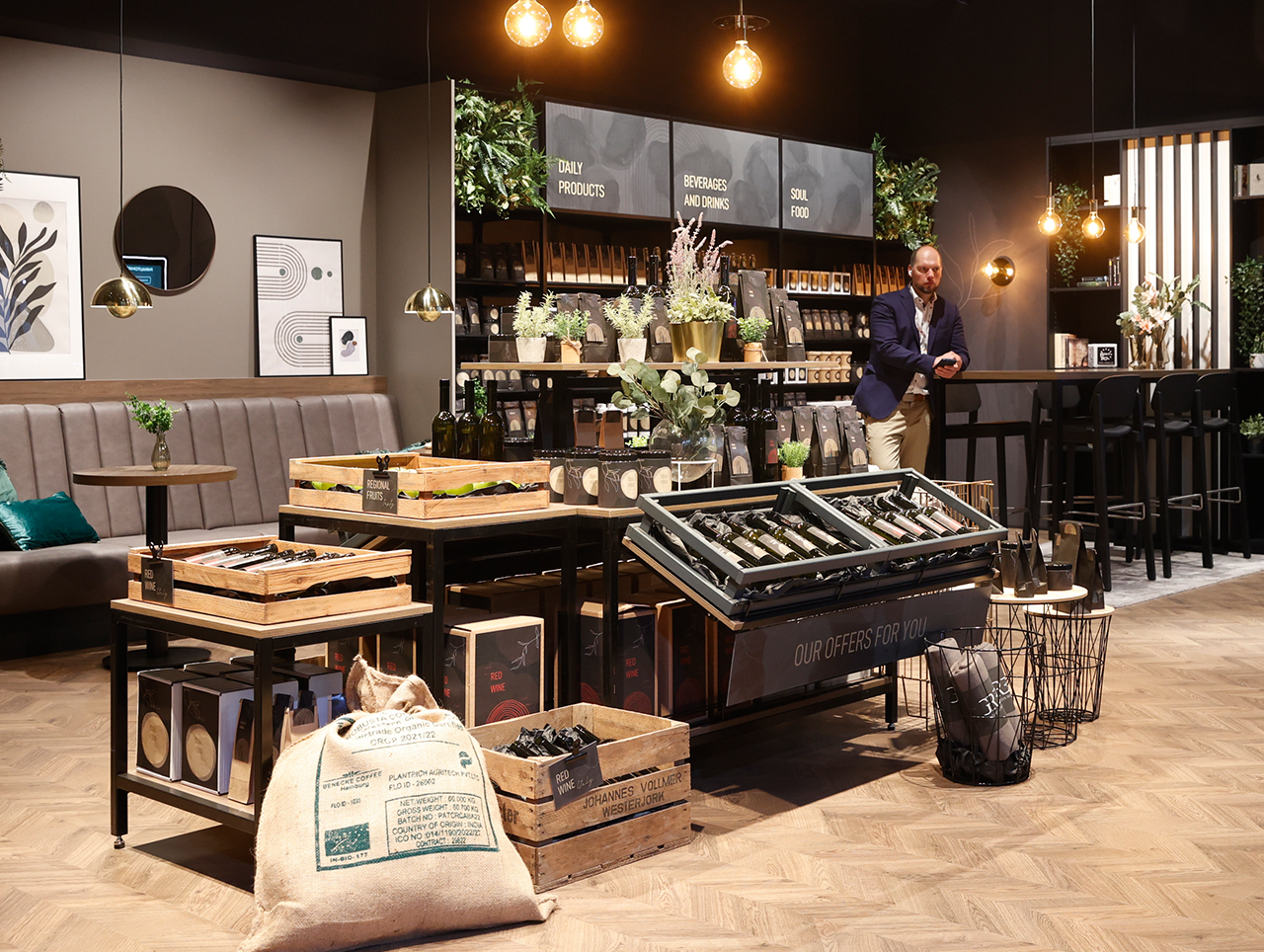
As part of EuroShop, international expert panels honor the world’s most successful concepts in retail technology (reta awards), design (EuroShop RetailDesign Award), science (Science Award), and stand design (Exhibitor Magazine’s EuroShop Awards).
Find the awards here.
Artificial intelligence is fundamentally transforming planning, merchandise management, and customer engagement in retail. Ultimately, the decisive moment occurs at checkout, determining efficiency, trust, and shopping experience. Self-checkout, mobile payment points, and hybrid store concepts require flexible, software-based payment solutions. Many retailers are relocating the checkout process: consultation, product selection, and payment take place directly on the sales floor. This requires integrated payment infrastructures combining speed, payment security, and omnichannel capabilities. With the digital payment system Wero, the European Payments Initiative aims to merge national solutions such as Giropay and Paydirekt into a unified European system to simplify retail payments in the long term. Payment service providers, acquirers, and payment technology companies such as Verifone, Computop, S-Payment, Epay, and others demonstrate at EuroShop how various cashless payment methods can be implemented technologically — also with regard to the retail sector’s key interface with customers.