
Project


Hermès has maintained a presence on London’s New Bond Street for many years and continues to see significant potential in the location. Following the closure of its previous store last week, the company has now opened a new flagship destination. The project was developed over nearly two decades, with Hermès having acquired the site as early as 2009. The new location sets new benchmarks in both scale and design, reflecting an exceptionally high level of investment. The complex extends far beyond the scope of a traditional retail store.
Located at 166 New Bond Street and extending into Grafton Street and Albemarle Street, the address becomes the brand’s sixth “Maison” worldwide and is regarded as a strategic milestone. The complex comprises six listed heritage buildings with a total area of nearly 2,000 square meters. It houses more than 500 artworks, carefully selected for the site under the direction of Artistic Director Pierre-Alexis Dumas. According to the company, the Maison “celebrates” the evolution of Hermès in the United Kingdom and showcases the House’s 16 métiers (crafts) in bespoke spaces.
Originally begun in 1769, the building was expanded over the decades into a network of interconnected structures that now spans five floors. Its scale is evident in its more than 55 rooms, four staircases, three elevators, and rooftop terraces.
Each room combines historical character with contemporary elements. Visitors can discover original architectural features alongside newly designed surfaces, color schemes, and decorative details created by the Paris-based architecture firm RDAI under the leadership of Denis Montel.
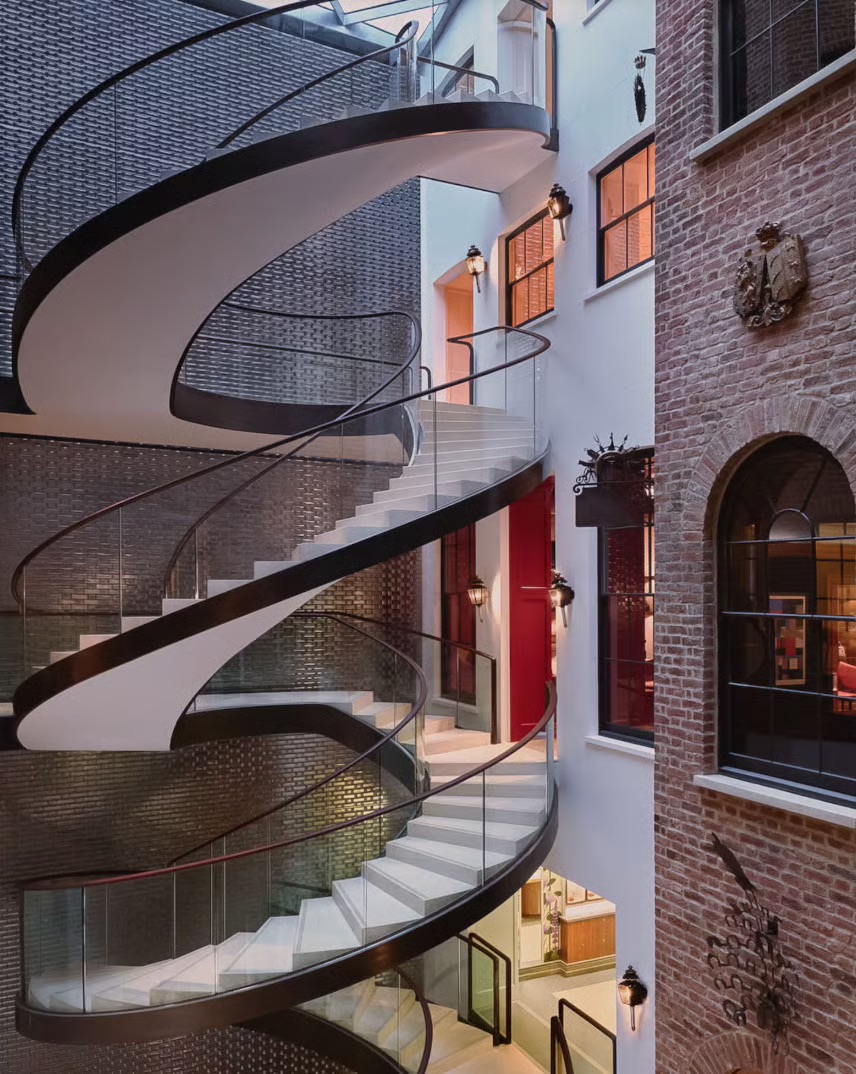
A seven-meter-high façade dominates the entrance area. Beneath it stretches a vaulted ceiling that echoes the six arches of the display windows. The journey through the silk department leads to an atrium that was originally conceived as an open courtyard. It has been redesigned by Foster + Partners with a steel-and-glass roof and a central spiral staircase.
The staircase, crafted from limestone and glass with a leather-covered handrail, extends across multiple levels. The former mirrored south wall has been replaced by a design featuring glass-mirrored brick structures.
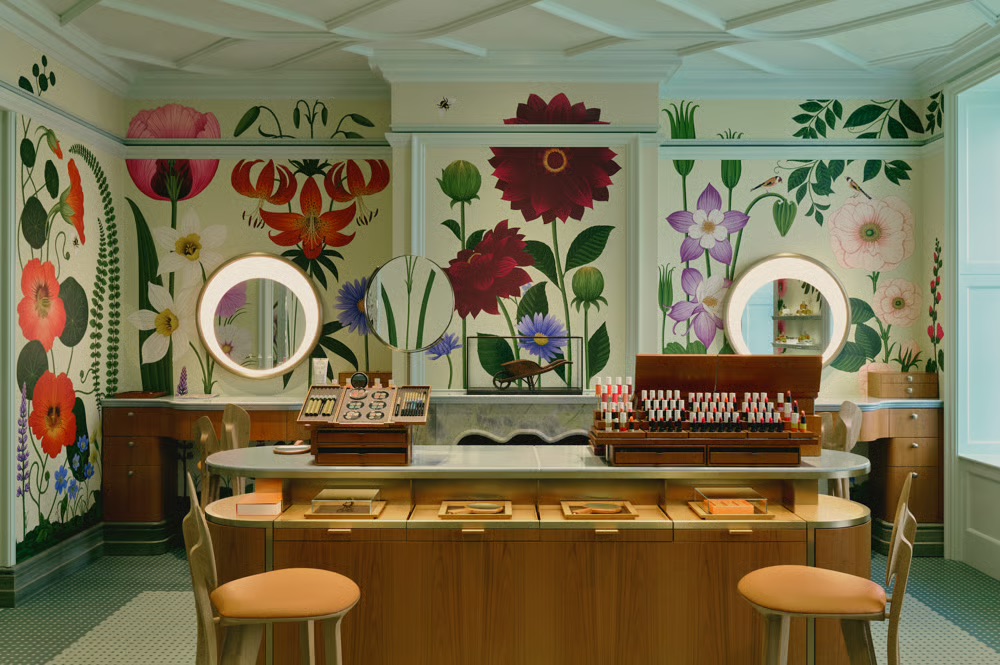
The art collection includes photography, illustrations, and contemporary works, as well as a specially commissioned horse sculpture by British artist Jessica Wetherly displayed in the atrium. Through the second entrance, visitors enter the beauty, fragrance, and fashion jewelry departments, presented as an “imaginary orangery” featuring wall designs by London-based illustrator Katie Scott. Ascending to the first floor, guests encounter 20 interconnected rooms, beginning with the red-toned spaces dedicated to the leather goods collections.
Panels of patinated copper lead to two private lounges and onward to the home collections. Considerable effort is evident in this area: at the center of the floor, the complete equestrian collection is displayed in a room overlooking the atrium, featuring boiserie crafted from straw and horsehair marquetry. Along the façade, six intimate rooms are dedicated to watches and jewelry.
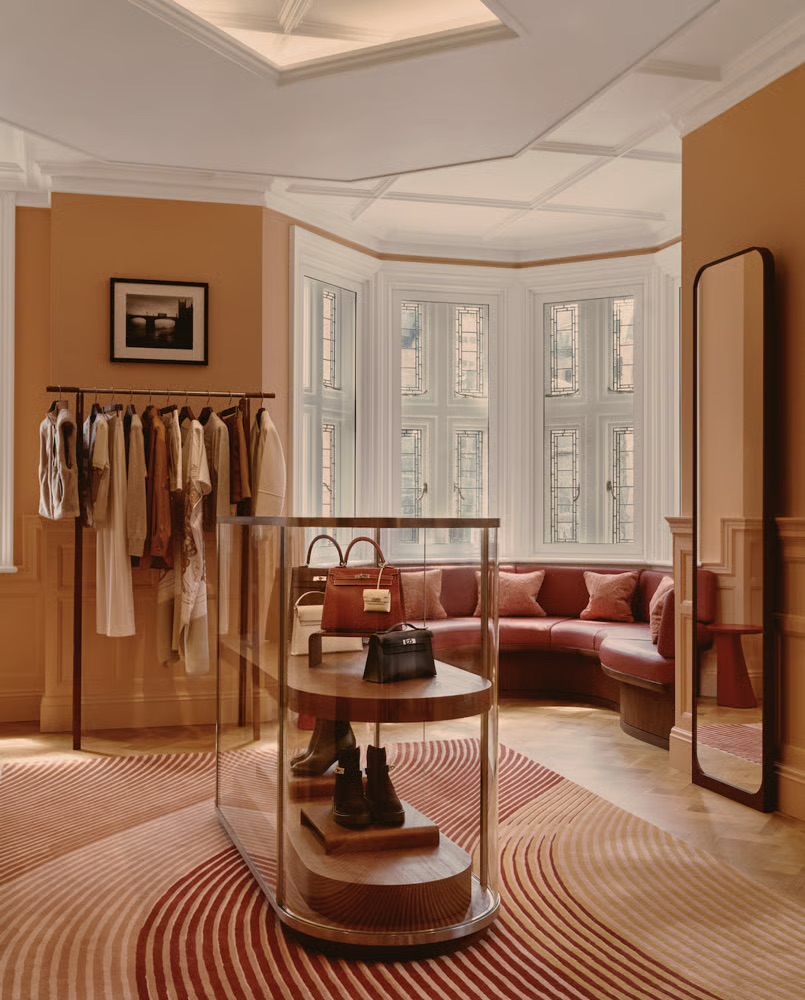
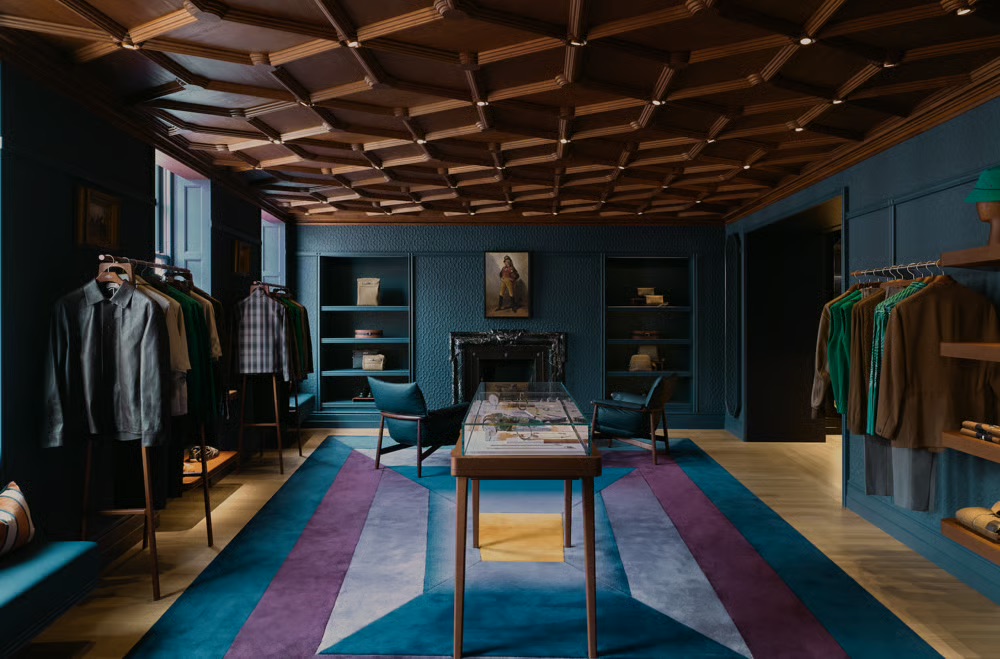
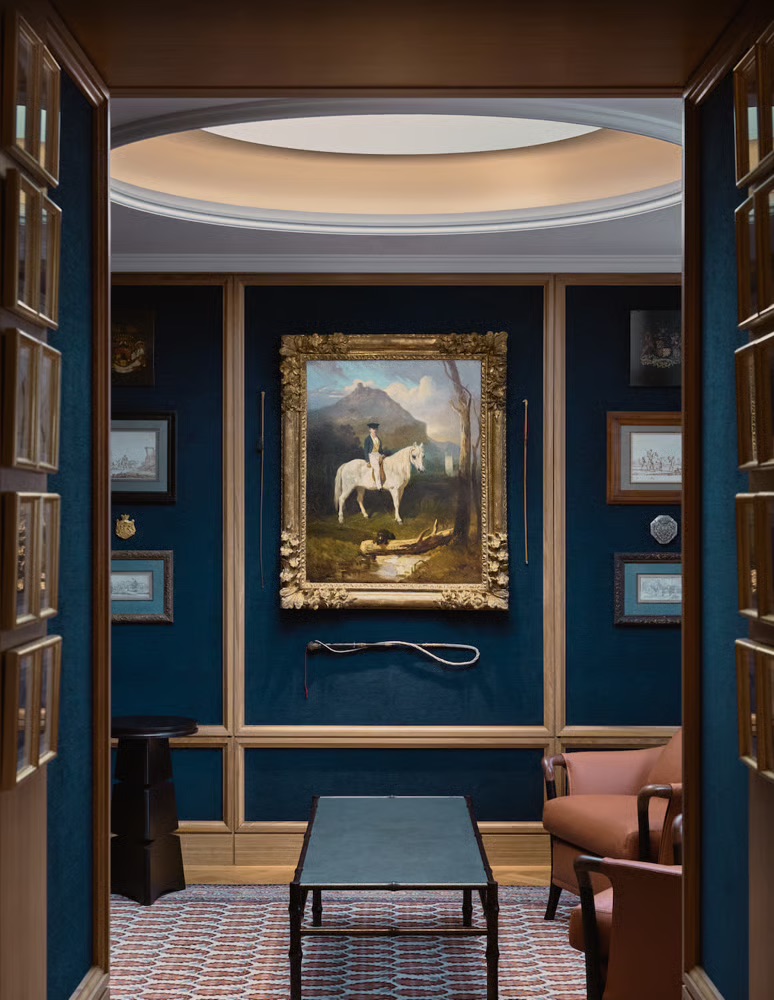
The second floor begins with the women’s footwear department, housed in a room with hand-finished walls and ceilings made from powder-pink mineral plaster, complemented by classic wood paneling and floral carpets. Original 19th-century mosaic floors connect two private salons with the women’s ready-to-wear area, whose pink-toned walls are enhanced by a series of hand-tufted carpets. For men, a dedicated area stretches along the New Bond Street frontage, featuring restored oak flooring and geometric carpets. The walls are clad in textured deep-blue wall coverings produced in Lancashire, based on Victorian-era designs. The floor also includes a relaxation area for tea or coffee, offering views over the atrium.
On the third floor, Hermès leather artisans work on objects designed “to last, to grow more beautiful over time, to be repaired, and to be passed on.” The fourth floor, accessible only privately, is devoted to the Émile Hermès Collection, a space conceived as a tribute to the private collection housed at 24 Rue du Faubourg Saint-Honoré in Paris. The rooftop lounges ultimately open onto two gardens.
The new store also offers a selection of exclusive products across various categories, including a set of stainless-steel gardening tools with leather handles and an apron made of red denim and leather. To mark the opening, the windows at 166 New Bond Street feature “The Rocabarn,” an installation by British artist Kate Jenkins—an imaginary horse-grooming salon created through crochet, knitting, and embroidery techniques.